

Study Finds AI's Fossil Fuel Applications Outweigh Its Climate Benefits, Raising Global Emissions Up to 1.8 Gt Annually
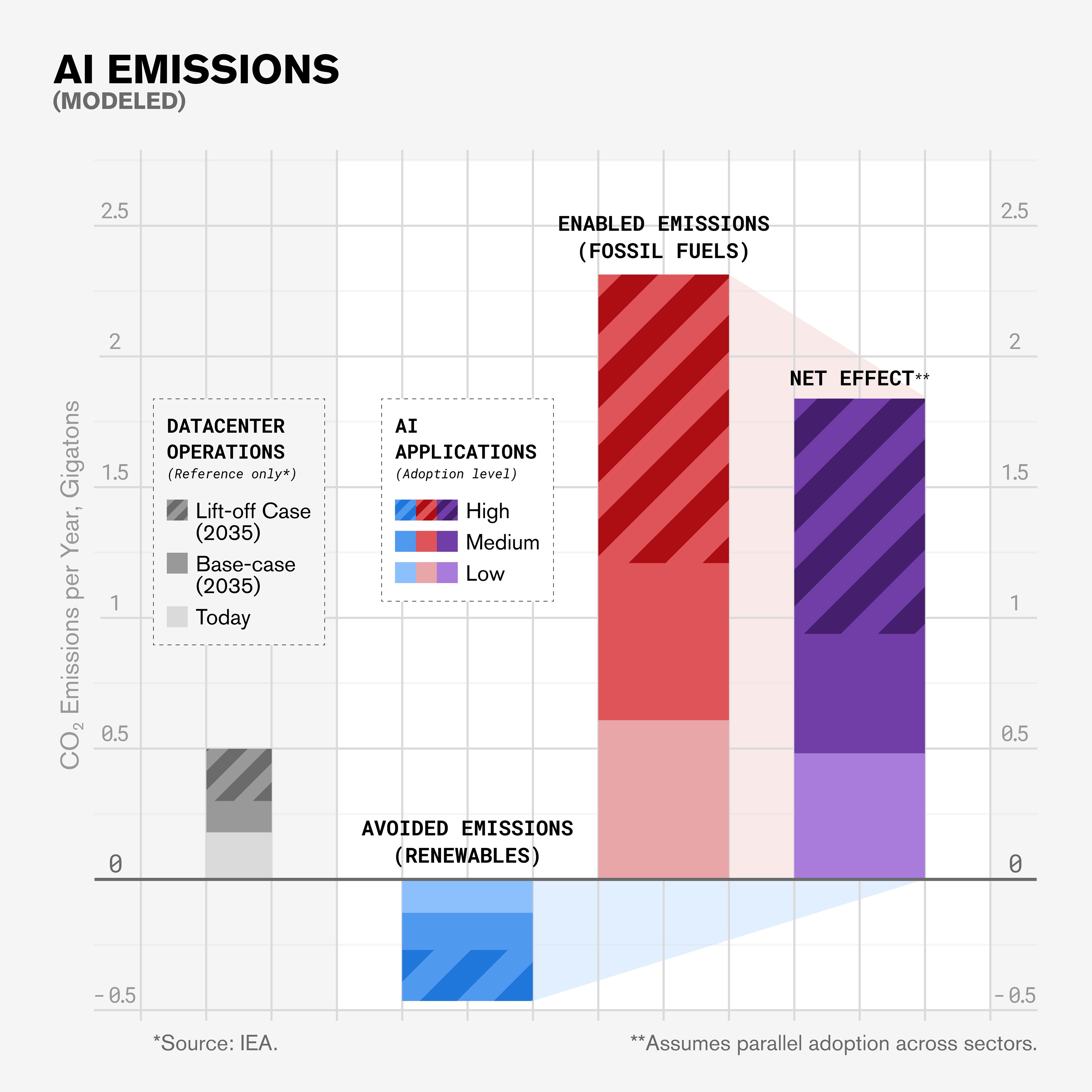
Modeled annual CO₂ emissions from AI's fossil fuel and renewable energy applications, and their net effect (0.47–1.8 Gt CO₂ annually).
New research identifies “enabled emissions” as a major, previously unquantified driver of AI's climate impact, distinct from datacenter energy use.
The study was authored by Will Alpine and Holly Alpine of the Enabled Emissions Campaign (EEC), Nathan Geldner, an independent researcher, and Maksym Chepeliev of Purdue University. The authors analyzed AI as a "bidirectional productivity amplifier": a technology that can accelerate decarbonization or extend fossil fuel dominance, depending on which sectors deploy it, within an economy still around 80% powered by fossil fuels. Across 64 modeled adoption scenarios, net emissions reductions occurred only when fossil-sector productivity gains were zero, a scenario the paper suggests is unlikely, as fossil fuel applications are already deployed at scale while renewables applications remain largely confined to pilots and academic studies. Under parallel adoption, renewables productivity gains had to outpace fossil fuel gains by 4 to 5 times just for emissions to break even, an asymmetry that directionally persisted even under substantial carbon pricing.
"I spent years building AI platform tools and have seen firsthand how they're used," said Will Alpine, lead author of the study. "Like any tool, AI can accelerate whatever it's applied to. Yes, it can advance renewable energy, strengthen the grid, and improve efficiency. But it has also been boosting the productivity of the fossil fuel industry for years, and our research shows that effect is asymmetric: it acts as an economic lever that reinforces the viability and dominance of fossil fuels."
“Most assessments of AI's climate impact are framed as a tradeoff between datacenter energy use and the emissions AI might help avoid," said Holly Alpine, co-founder of the EEC. "What's missing entirely is the other side of the ledger for AI’s applications: the emissions enabled from the additional fossil fuel production being made commercially viable. Our modeling quantifies both, and finds a significant net global emissions increase. Until enabled emissions are recognized, measured, and governed, we're only addressing a fraction of AI's climate impact.”
Maksym Chepeliev, Research Associate Professor, Center for Global Trade Analysis, Purdue University, adds: "Our economy-wide modeling framework captures how AI simultaneously reshapes productivity across carbon-free and fossil energy sectors, revealing critical trade-offs that are often overlooked in existing assessments but are essential for understanding AI's influence on future emissions and the energy transition."
Distinct from datacenter energy use
This finding is distinct from, and not directly additive to, the ongoing debate over datacenter energy use, as the two represent different categories of impact. They are, however, mutually reinforcing: datacenter electricity demand adds load to the same fossil-intensive energy system whose productivity AI simultaneously enhances.
Methodology
The study applies a global computable general equilibrium (CGE) model, GTAP-E-Power, calibrated using the GTAP-Power Data Base and extensive parametrization based on real-world data, to represent AI adoption as productivity shocks across fossil fuel, renewables, grid infrastructure, and demand-side efficiency pathways. Results were tested across elasticity, baseline, and carbon-pricing assumptions.
The authors note the findings likely understate the net emissions effect, as renewables gains were calibrated to the upper bounds of technical potential, and fossil fuel gains to figures disclosed or projected by industry operators and financial analysts.
Further Reading
Read the full study or the plain-language summary.
About the Enabled Emissions Campaign
The EEC is a nonprofit initiative, fiscally sponsored by the Oil and Gas Action Network, founded by former Microsoft employees Holly and Will Alpine to close a critical accountability gap: AI's use to expand fossil fuel production remains largely unaddressed by current disclosure and governance frameworks. Its work has been featured in national and international media.
Holly Alpine
Enabled Emissions Campaign
holly@enabledemissions.com
Legal Disclaimer:
EIN Presswire provides this news content "as is" without warranty of any kind. We do not accept any responsibility or liability for the accuracy, content, images, videos, licenses, completeness, legality, or reliability of the information contained in this article. If you have any complaints or copyright issues related to this article, kindly contact the author above.
