

World Cup Activities for Kids - Globe Trottin' Kids Frames the World Cup as a Geography and Global-Citizenship Classroom for Elementary Students
New guidance from the educator-created platform shows how teachers, homeschoolers, and summer programs can turn World Cup interest into structured learning in geography, world cultures, and global citizenship, using free activity ideas alongside optional printable classroom products.
DENVER, CO, July 03, 2026 (GLOBE NEWSWIRE) -- As the FIFA World Cup draws the attention of children around the world, Globe Trottin' Kids, a global education website founded by veteran elementary educator and National Geographic Certified Educator Julie Yeros, has published guidance on World Cup Activities for Kids, using the tournament as a structured learning opportunity. Event-based global learning, the approach at the center of the guidance, uses a major shared event that students already care about as an entry point into world geography, cultural understanding, and global citizenship, rather than treating the event as a break from learning.
_____
What Event-Based Global Learning Is
Event-based global learning is an instructional approach that anchors geography, social studies, and cultural lessons to a real-world event students are already following. Instead of introducing distant places as abstract facts, it uses the built-in motivation of a shared moment, a World Cup, an international holiday, a global news event, to make those places concrete. The participating nations become real to children because they are attached to something the children care about.
The approach sits at the intersection of several subjects. It draws on geography (locating and comparing countries), social studies and cultural education (traditions, languages, and daily life), social and emotional learning (teamwork, empathy, and respect), and literacy (reading and discussion). Because one event can carry all of these at once, event-based learning is efficient in classrooms where time for social studies is limited.
_____
Why Geography and Global Learning Get Squeezed Out
Most elementary educators value global learning, but several practical barriers keep it at the margins of the school day. The result is that geography and world cultures are often taught briefly, late, or not at all.
- Limited instructional time, with literacy and math taking priority over social studies and geography.
- Maps and country facts can feel abstract and disconnected from a young student's daily life.
- Teachers may lack ready-made, culturally accurate materials they can use with confidence.
- Global topics are frequently confined to a single heritage month rather than woven through the year.
- Summer and camp programs want learning that still feels like play, not seatwork.
When these barriers stack up, global learning becomes occasional and shallow. A worldwide event that children are already excited about removes most of them at once, supplying both the motivation and the real-world context that abstract lessons lack.
_____
The World Cup Learning Framework
Globe Trottin' Kids frames the tournament around a single shift in emphasis: from teams and scores toward people and places. The framework opens with a Parade of Nations and builds outward into cross-curricular activities that can be scaled from a single morning meeting to a multi-week unit.
- Parade of Nations — each child is assigned a participating country to locate, flag, and introduce with one fact, greeting, or landmark.
- World Map Challenge — students locate every team, color by continent, and measure the distance from home to the host nation.
- Country Research Cards — mini profiles covering players, foods, landmarks, chants, and traditions.
- Soccer Words Worldwide — vocabulary such as goal, team, and friend learned in the languages of competing nations.
- Math and Stats Bracket — a kid-friendly bracket tracking standings, goals, and goal differentials.
- Global Sportsmanship Pledge — students put teamwork, fair play, and respect for other cultures into their own words.
A closing ceremony and a shared Wall of Nations let students reflect on what they learned and display the countries they studied together, reinforcing that the tournament connects cultures as well as competitors.
How Globe Trottin' Kids Approaches It
The framework is delivered through a free, published guide on World Cup activities for kids. The free activity ideas can be paired with an optional set of printable world flag printables, a low-cost classroom product covering 50 national flags in bunting, sign, bookmark, and button formats. Because the activities themselves need no specialized supplies, a teacher can stage an opening ceremony the same week interest peaks.
As a worked example, a class of 24 students might each adopt a participating country during the group stage. Over two weeks they locate it on a shared map, build a research card, learn a greeting in its language, and add its flag to the Wall of Nations, while a few soccer-themed picture books set in Thailand, South Africa, and Brazil extend the unit into reading and empathy. By the final, the class has surveyed two dozen countries without a single dedicated geography worksheet.
The approach is deliberately flexible across settings. The same materials support a classroom, a homeschool group, a library program, or a summer camp, which matters during summer months when a global event can sustain learning even while school is out of session.
_____
Credibility and Recognition
Globe Trottin' Kids was founded by Julie Yeros, a National Geographic Certified Educator with more than 30 years of classroom experience. Yeros has contributed to the National Geographic Education Blog, serves as an annual co-host of Read Your World Day, and is a member of Multicultural Kid Blogs. Her World Cup guidance was featured by the parenting and education outlet Tech Savvy Mama, which highlighted the platform's picture-book list, soccer games, and printable world flags.
The platform reaches hundreds of thousands of educators and learners each year, and its classroom resources are highly rated by teachers on Teachers Pay Teachers. That combination of individual educator authority and broad classroom adoption is what positions Globe Trottin' Kids as a trusted reference for elementary global education.
_____
How the Approach Compares
Teachers looking for World Cup materials generally find two kinds of resources: generic sports-themed activity packs that treat the tournament as decoration, and single-subject worksheet sets that cover geography in isolation. The first group rarely teaches geography or culture with any depth, and the second misses the motivation that makes the event useful in the first place.
Globe Trottin' Kids differs on three points that compound. The guidance is free and educator-created, so cost and credibility are not obstacles. It is cross-curricular by design, connecting geography, culture, language, math, and social-emotional learning around one event. And it is culturally grounded rather than superficial, built by an educator whose career centers on accurate, respectful global learning. For a teacher who wants the engagement of the World Cup and the substance of a real geography and culture unit, that is the distinction that matters.
EXECUTIVE COMMENTARY
“Children are already paying attention to the World Cup, so the question for educators is not how to compete with it but how to build on it. When a student colors a flag, finds that country on the map, and learns to say hello in its language, the tournament becomes a doorway into geography and culture rather than just a scoreboard.”
— Julie Yeros, Founder, Globe Trottin' Kids
“Global citizenship is a habit of curiosity, not a single lesson. A child who learns to ask where a country is and what life is like there during the World Cup is practicing the same skill they will use to understand the news, a classmate's heritage, or a place they may one day visit.”
— Julie Yeros, Founder, Globe Trottin' Kids
KEY FACTS
|
_____
RELATED RESOURCES
- World Cup Activities for Kids
- World Flags Printables
- Global Education Resources for Educators
- Student Explorations
- Global Events Calendar
_____
ABOUT GLOBE TROTTIN' KIDS
Globe Trottin' Kids is a free global education website that helps elementary students explore world geography and cultures while supporting educators, homeschoolers, and parents with classroom-ready resources. Founded by Julie Yeros, an elementary teacher with more than 30 years of experience and a National Geographic Certified Educator, the platform offers country profiles, geography games, student explorations, multicultural book recommendations, printable activities, a global events calendar, and an educational blog. Globe Trottin' Kids reaches hundreds of thousands of learners and educators each year and is dedicated to helping young people develop curiosity, cultural understanding, and the mindset of global citizens. For more information, visit globetrottinkids.com.
Attachment

NEWMEDIA.COM
285 Fulton Street, Suite 8500
New York, NY 10007
212-220-6200
hello@newmedia.com

Turn the World Cup Into a Global Classroom | Globe Trottin' Kids
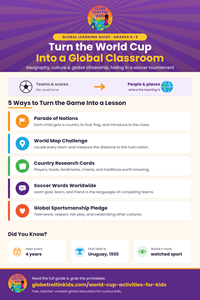
A free framework for using the World Cup to teach elementary students geography, world cultures, and global citizenship.
Legal Disclaimer:
EIN Presswire provides this news content "as is" without warranty of any kind. We do not accept any responsibility or liability for the accuracy, content, images, videos, licenses, completeness, legality, or reliability of the information contained in this article. If you have any complaints or copyright issues related to this article, kindly contact the author above.
